Last updated: July 2026
If you are buying RCC Hume pipes for a drain, culvert or irrigation line, the first question any manufacturer will ask you is: NP2 or NP3? Pick too low a class and the pipe can crack under traffic load. Pick too high a class and you pay for steel and concrete you did not need. This guide explains the difference between NP2 and NP3 pipes under IS 458, which situations call for which class, and how to specify the right pipe in your BOQ or tender.
BKN Group of Industries has manufactured RCC spun pipes as per IS 458 specifications since 1998 — NP2 and NP3 classes, 300 mm to 1600 mm diameter at our Kunigal unit, and up to 1200 mm at Tiptur. We supply contractors, gram panchayats and government tender works across Tumkur, Hassan, Chikmagalur, Chitradurga and the rest of Karnataka.
What the NP Classes Mean Under IS 458
IS 458:2021 (Precast Concrete Pipes — with and without reinforcement) is the Indian Standard that governs RCC pipes. It divides non-pressure pipes into four classes — NP1 to NP4 — based on the duty (loading) the pipe is designed to carry. "NP" stands for non-pressure: these pipes carry water by gravity flow only. Pressure pipes have their own classes (P1, P2, P3) and are hydrostatically rated — a separate family altogether.
| Class | Reinforcement | Duty level | Typical use |
|---|---|---|---|
| NP1 | Unreinforced | Very light | Drainage and irrigation above ground or in shallow trenches |
| NP2 | Reinforced | Light duty | Drainage, irrigation, cross drains and culverts under light traffic |
| NP3 | Reinforced | Medium duty | Drainage, irrigation, cross drains and culverts under medium traffic |
| NP4 | Reinforced | Heavy duty | Culverts and cross drains under heavy traffic, e.g. national highways |
In practice, NP2 and NP3 cover the overwhelming majority of rural and semi-urban work in Karnataka — village drains, irrigation channels, panchayat road culverts, state road cross drains and stormwater lines. BKN manufactures NP2 and NP3 classes. NP4 is described here for education only, so you can recognise it when a highway specification calls for it.
The Load-Bearing Difference: What the Three-Edge Bearing Test Means
The strength class of an RCC pipe is defined by the three-edge bearing test described in IS 458. In this test, a pipe is supported along two bearing strips at the bottom and a load is applied along the crown (top line) of the pipe until it reaches a specified crack load and ultimate load. The higher the class, the higher the crush load the pipe must withstand for the same diameter.
Two things let an NP3 pipe carry more load than an NP2 pipe of the same diameter:
- Thicker barrel wall. NP3 pipes have a heavier wall section than NP2 at every diameter. The exact wall thickness for each diameter and class is laid down in IS 458 tables — detailed spec sheet available on request.
- More steel reinforcement. NP3 pipes carry a heavier reinforcement cage (more longitudinal and spiral steel), which is what resists cracking under crown load.
The specified crack and ultimate loads for each diameter and class are tabulated in IS 458 — as per IS 458 tables, detailed spec sheet available on request. The practical takeaway is simple: same diameter, same flow capacity — but NP3 survives heavier loading from soil fill and vehicles above it.
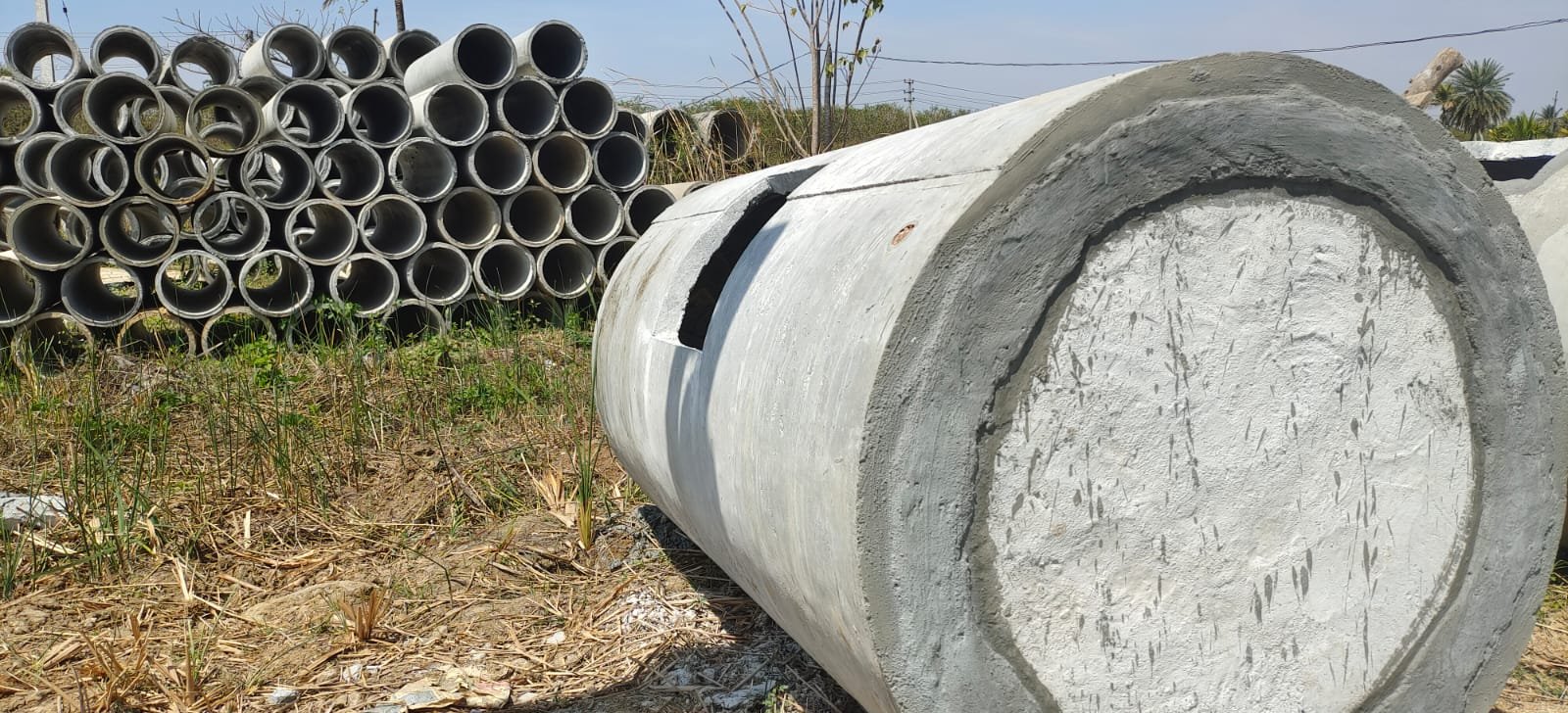
IS 458 also specifies hydrostatic, permeability and water absorption tests to check that the concrete is dense and impervious. At BKN we follow strict in-house quality control on every batch — controlled batching of concrete, proper water curing, and dimensional and visual inspection of every pipe before despatch. You can read more about these tests in our IS 458 standard explained guide.
Decision Guide: Which Class for Which Situation
Use this table as a first-cut guide. The final call always rests with the project engineer, who considers trench depth, fill height, bedding type and the actual traffic the line will see.
| Situation | Recommended class | Why |
|---|---|---|
| Farm drain, irrigation channel, field crossing | NP2 | Light or no vehicle loading; NP2 handles it economically |
| Village lane / internal layout stormwater drain | NP2 | Occasional light vehicles only |
| Culvert under a panchayat or farm access road (light traffic) | NP2 | IS 458 assigns light-traffic cross drains to NP2 |
| Cross drain under a district or state road (medium traffic) | NP3 | Regular truck and bus traffic needs medium-duty strength |
| Pipe under deep earth fill / high embankment | NP3 | Soil load rises with fill height even without traffic |
| Large-diameter line (above ~900 mm) under any road | NP3 | At larger diameters NP3 is generally preferred over NP2 |
| Culvert on a national highway (heavy traffic) | NP4 (educational — check project spec) | IS 458 assigns heavy-traffic culverts to NP4 |
For a fuller treatment of bedding, cover depth and culvert sizing, see our culvert pipe selection guide.
Cost Difference: NP2 vs NP3
Because NP3 uses a thicker wall and a heavier steel cage, it costs more than NP2 at every diameter — typically in the range of roughly 20–40% more for common sizes, with the gap tending to narrow at very large diameters. Steel content is the biggest driver, so the difference moves with steel prices.
| Diameter | NP2 (₹ per 2.5 m pipe) | NP3 (₹ per 2.5 m pipe) |
|---|---|---|
| 300 mm | ₹1,100 – ₹1,700 | ₹1,500 – ₹2,500 |
| 450 mm | ₹1,400 – ₹2,400 | ₹2,400 – ₹3,300 |
| 600 mm | ₹2,400 – ₹3,800 | ₹3,800 – ₹5,200 |
| 900 mm | ₹5,000 – ₹7,500 | ₹6,500 – ₹9,500 |
All prices above are indicative, ex-factory, excluding GST, loading and transport, and vary with cement & steel prices — call for today's rate. Collars, transport and unloading are charged separately. See our RCC pipe price guide for the full size range.
Do not let the price gap tempt you into under-specifying. A cracked NP2 culvert under a busy road costs far more to excavate and replace — road cutting, traffic diversion, fresh pipes, fresh bedding — than the original saving on pipe class.
Common Mistakes We See on Site
- Using NP2 under roads with regular truck traffic. The single most common error. The pipe may survive for a while, then crack at the crown once loading and fill settle. Medium-traffic cross drains call for NP3.
- Assuming class affects flow. It does not. A 600 mm NP2 and a 600 mm NP3 carry the same water. Class is about crush strength, not capacity.
- Ignoring fill height. Even with no traffic, a pipe under a tall embankment carries heavy soil load. Deep fill is an NP3 situation.
- Compensating for low class with "extra concrete around the pipe". Ad-hoc encasement is no substitute for the correct pipe class with proper bedding as per the design.
- Not specifying the class at all in the purchase order. "600 mm RCC pipe" is ambiguous — the supplier may quote NP2 while the drawing intends NP3. Always write the class.
- Poor bedding and joint workmanship. Even the right class fails early if laid on uneven ground or with badly made joints. Our RCC pipe installation guide covers laying, bedding and jointing.
How to Specify NP2/NP3 in a BOQ or Tender
A clean BOQ line removes all ambiguity. Include, at minimum: standard, class, diameter, effective length, joint type, and what is included in the rate. A model description:
Practical pointers when drafting or checking a tender item:
- Name the standard and edition — "IS 458:2021" — so there is no dispute about which tables apply.
- State the class explicitly (NP2 or NP3). Never leave it to be inferred from the diameter.
- Specify the joint type. IS 458 covers spigot & socket (rubber ring), collar, and flush joints. Collar-jointed NP2 and flush-jointed NP3 pipes are the usual choice for culverts and cross drains; flexible rubber-ring joints are used for other non-pressure lines.
- State the effective length — standard lengths are 2.0 m and 2.5 m (IS 458 permits up to 4 m for larger diameters) — and whether the rate is per metre or per pipe.
- Clarify inclusions: collars, rubber rings, GST, transport and unloading are commonly priced separately. Say which are in the rate.
If you send us your BOQ extract on WhatsApp, we will confirm the matching class, diameter and joint from our production range and give you a current ex-factory quote the same day.
Frequently Asked Questions
Can I use NP2 pipes under a road?
Only where the crossing carries light traffic — a farm access track or an internal village lane — and with proper bedding and cover. For cross drains under roads carrying medium traffic, IS 458 intends NP3. Heavy-traffic culverts, such as those on national highways, fall under NP4. When in doubt, get the class confirmed by the project engineer.
How much costlier is NP3 than NP2?
Roughly 20–40% more for common diameters, because of the thicker wall and additional steel. The gap narrows at very large sizes. All figures are indicative, ex-factory, and move with cement and steel prices — call us for today's rate.
Does BKN Group manufacture NP4 pipes?
No. We manufacture NP2 and NP3 class RCC spun pipes as per IS 458 specifications — 300 mm to 1600 mm at Kunigal (our main unit, running since 1998) and up to 1200 mm at Tiptur. NP4 is covered on this page for education only, so you can recognise when a specification requires it.
What lengths and joints do NP2 and NP3 pipes come in?
Standard effective lengths are 2.0 m and 2.5 m, with IS 458 permitting longer lengths up to 4 m for larger diameters. Joint options under IS 458 are spigot & socket (rubber ring), collar, and flush joints; collar-jointed NP2 and flush-jointed NP3 pipes are typically used for culverts and cross drains. Wall thickness and reinforcement are as per IS 458 tables — detailed spec sheet available on request.
Need RCC pipes for your project?
Factory-direct prices from our Kunigal & Tiptur units. Serving all of Karnataka since 1998.
📞 7760337303💬 WhatsApp UsRelated Guides
- IS 458 Standard Explained — the full standard behind RCC pipes: classes, tests, joints and lengths in plain language.
- RCC Pipe Price Guide — indicative ex-factory price ranges for NP2 and NP3 across all diameters.
- Culvert Pipe Selection Guide — sizing, bedding and cover depth for road cross drains.
- RCC Pipe Installation Guide — trenching, bedding, jointing and backfilling done right.