Last updated: July 2026
Most cross-drainage works on village and panchayat roads do not need a big bridge or a box structure. A properly selected RCC pipe culvert does the job at a fraction of the cost — if the diameter, class and installation are right. This guide covers culvert pipe selection in the order you actually decide on site: type, size, class, barrels, bedding and headwalls.
What Is a Pipe Culvert?
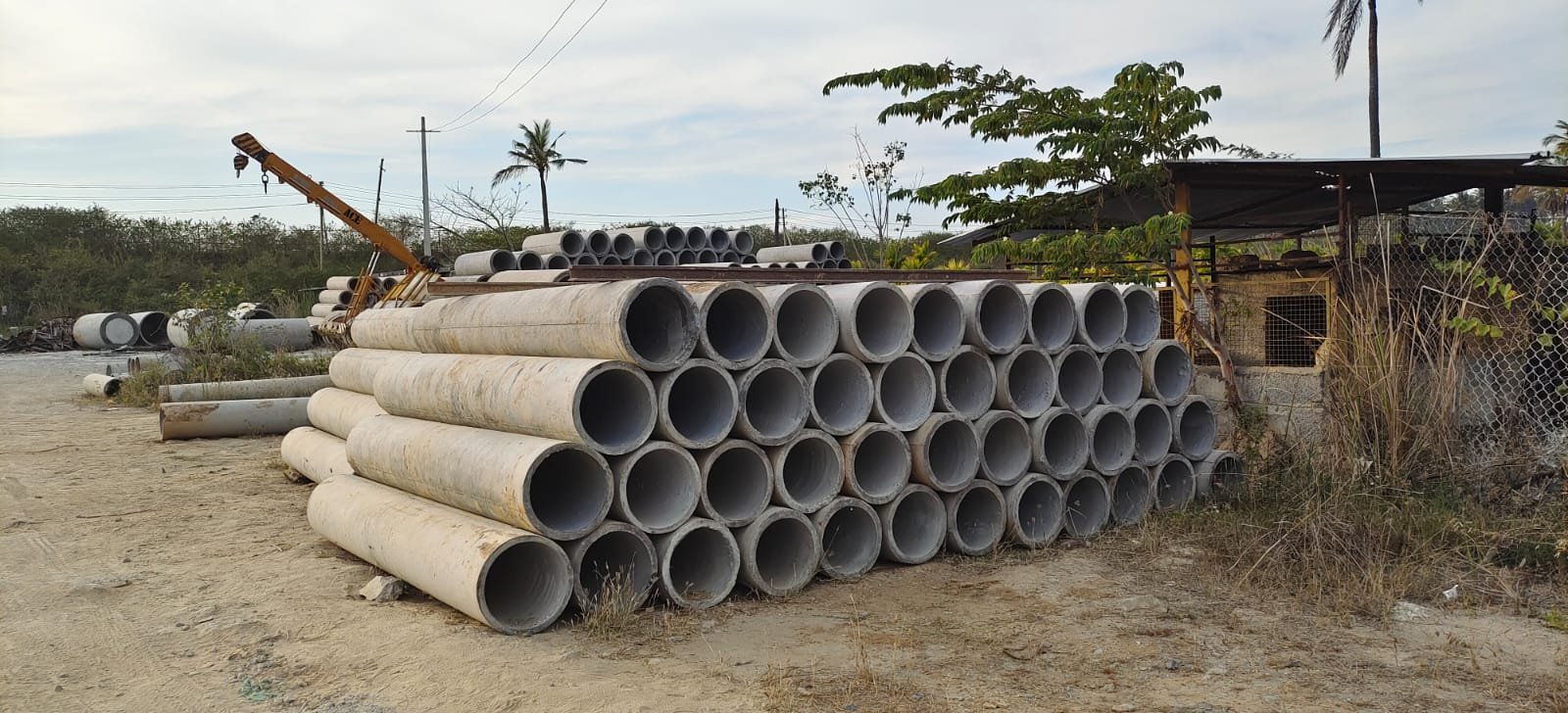
A pipe culvert is one or more RCC pipes laid across the road alignment, below the formation, so that stream flow, tank overflow or channel water passes from one side to the other without cutting the road. The pipes sit on prepared bedding, jointed, covered with compacted earth cushion, and finished with headwalls at both ends.
For culvert duty, the pipes used are non-pressure (NP) class RCC pipes manufactured as per IS 458:2021 — water flows through them by gravity, not under pumping pressure. The common classes for road crossings are NP2 and NP3, discussed in detail below.
When a Pipe Culvert Beats a Box Culvert
Box culverts (cast-in-situ or precast rectangular structures) have their place on major roads and wide streams. But for the typical rural crossing, pipe culverts win on three counts:
- Cost: Factory-made pipes plus simple headwalls cost far less than shuttering, reinforcement and casting a box on site.
- Speed: Pipes arrive ready. A small crossing can be excavated, laid, jointed and backfilled in a few days, keeping road closure short.
- Simplicity: Laying needs a JCB, a compactor and a mason for headwalls — no carpentry, no bar bending, minimal on-site curing supervision.
A box culvert is the better option when the required waterway opening is very large (beyond what two or three big pipes can carry), when vertical height is too little for a pipe plus earth cushion, or when the departmental drawing specifies a box. For everything smaller, pipes are the economical answer.
Choosing the Diameter (Culvert Pipe Size)
Diameter is a hydraulic decision: the opening must pass the peak flow of the catchment draining to that point, with margin for silt and debris. A few honest rules of thumb for small works:
- Never go below 600 mm for a road crossing. Smaller pipes clog with silt, plastic and branches and are practically impossible to clean out.
- Small local catchments — roadside drain continuation, small field runoff — are usually served by a single 600 mm or 900 mm pipe.
- Defined streams, tank surplus channels and larger catchments call for 1000–1200 mm pipes, often in multiple barrels, or larger diameters.
- Look at the existing evidence: flood marks nearby, the old crossing's size and whether it overtopped in heavy rain. If it overtopped, go up in size or add barrels — never replace like-for-like.
BKN Group manufactures RCC spun pipes from 300 mm to 1600 mm diameter at Kunigal (since 1998) and up to 1200 mm at Tiptur, covering the full range of common culvert sizes locally in the Tumkur–Hassan belt.
Choosing the Class: NP2 vs NP3
Class is a structural decision: how much load will sit on the pipe, from the earth above it plus the traffic over it. Under IS 458:2021, NP2 is the light-duty non-pressure class and NP3 is the medium-duty class. (NP4 is a heavy-duty class for heavy traffic such as national highways; NP1 is unreinforced and not used under roads.)
| Factor | NP2 (light duty) | NP3 (medium duty) |
|---|---|---|
| Traffic over the culvert | Light traffic — village and internal panchayat roads, farm access, two-wheelers, cars, occasional light goods vehicles | Medium traffic — regular trucks, buses, loaded tractor-trailers; busier district and connecting roads |
| Earth cushion over pipe crown | Needs a good compacted cushion — as a common rule, at least about 600 mm; NP2 should not sit directly under wheel loads with thin cover | Preferred where cover is shallow or fill above the pipe is deep, since it carries higher loads |
| Typical culvert use | Cross drains and small culverts on lightly trafficked roads | Road culverts where loaded vehicles cross daily |
| Cost | Lower | Higher (more reinforcement and wall thickness) |
| Wall thickness & test loads | As per IS 458 tables — detailed spec sheet available on request | |
Practical rule: if loaded trucks or buses will cross regularly, or you cannot guarantee a proper cushion over the crown, specify NP3 — the saving from NP2 is not worth a cracked crown under a lorry axle. If the tender or drawing states a class, that always governs. For a deeper comparison, see our NP2 vs NP3 guide.
BKN manufactures both NP2 and NP3 by the spun (centrifugal) casting process, built to IS 458 specifications, with strict in-house quality control — controlled batching, full water curing, and dimensional and visual inspection of every pipe.
Single Barrel or Multi-Barrel?
When one pipe cannot carry the design flow, either go up in diameter or lay multiple pipes side by side (multi-barrel). Multi-barrel culverts suit sites where vertical space is limited — two 900 mm pipes need less height than one 1400 mm pipe. Keep in mind:
- Leave adequate clear spacing between barrels so backfill can be compacted between the pipes — poorly compacted soil there is a classic failure point.
- Lay all barrels to the same invert level and gradient so flow divides evenly and silt does not settle in one barrel.
- Two smaller barrels give redundancy — if one chokes, the crossing still functions until it is cleaned.
Bedding and Haunching Basics
More culverts fail from poor laying than from poor pipes. The pipe must bear evenly along its full length on prepared bedding — never on rock points or the bare trench bottom. The haunch zone (the pipe sides from bedding up to the springline) must be filled with selected material and compacted in layers, because that side support is what lets a buried pipe carry load. Backfill over the crown likewise goes up in compacted layers, and heavy machinery must not run over the pipe until the specified cushion is in place.
Trench width, bedding types, jointing and layer-by-layer backfilling are covered in detail in our RCC pipe installation guide — read it before your team lays the first pipe.
Headwalls and End Finishing
Headwalls at both ends are not decoration. They retain the road embankment so it does not slump over the pipe ends, hold the last pipe in place, guide water through the barrels, and reduce erosion. Typical rural practice is size-stone or CC block masonry headwalls with a small apron; on erodible soils, a downstream apron and curtain wall stop the outfall from scouring under the pipe. Build to the sanctioned drawing where one exists.
Common Culvert Failures (and Their Root Causes)
| Failure seen on site | Usual root cause | Prevention |
|---|---|---|
| Water overtops the road every monsoon | Undersized pipe or too few barrels | Size from catchment/flow, not from what was lying in the yard; when in doubt go one size up or add a barrel |
| Longitudinal cracks at the pipe crown | Wrong class — light-duty pipe under heavy wheel loads, or cushion too thin | Use NP3 where trucks cross; maintain the specified earth cushion |
| Road settles in a dip over the culvert; joints open | Poor compaction of haunch and backfill | Compact in layers with proper moisture; never bulk-dump backfill with the JCB bucket |
| Pipe ends exposed, embankment washing away | Missing or undersized headwalls and aprons | Build proper headwalls with aprons at both ends |
| Culvert silts up and stops flowing | Pipe too small to self-clean, or flat/reversed gradient | Minimum 600 mm diameter; lay to a steady gradient towards the outfall |
Checklist Before You Place the Order
Have these ready when you call the factory — it gets you an accurate quote in one call:
- Diameter — from the drawing or hydraulic assessment (e.g., 900 mm).
- Class — NP2 or NP3, based on traffic and cover, or as per tender.
- Number of pipes — culvert length ÷ effective pipe length (standard 2.0 m or 2.5 m), rounded up, × number of barrels.
- Joint type and collars — collar-jointed or flush-jointed pipes are the usual choice for road culverts; order matching collars with collar-jointed pipes.
- Delivery details — site location, approach road condition, unloading arrangement (crane/JCB), required date.
- Documentation — tell us if it is a government tender so invoices and spec sheets are prepared accordingly.
For budgeting, indicative rates for common culvert sizes are compiled in our RCC pipe price guide — all indicative, ex-factory, varying with cement and steel prices; call for today's rate.
Frequently Asked Questions
What is the minimum RCC pipe diameter for a road culvert?
Most departments prefer a minimum of 600 mm even where flow is small, because smaller pipes choke with silt and debris and are hard to clean. 450 mm is sometimes used for pure field-to-field irrigation crossings, but 600 mm is the safer practical minimum under a public road.
Should I use NP2 or NP3 pipes for a culvert?
Under IS 458:2021, NP2 is light-duty — for culverts under light traffic with a proper earth cushion. NP3 is medium-duty — the safer choice where trucks, buses or loaded tractor-trailers cross regularly, or where cover is shallow. If the tender specifies a class, follow the tender.
How many pipes do I need for one crossing?
Divide the culvert length (formation width plus headwall seating, per the drawing) by the effective length of one pipe — commonly 2.0 m or 2.5 m — and round up. A 7.5 m crossing with 2.5 m pipes needs 3 pipes per barrel; two barrels means 6 pipes, plus collars as applicable.
Does BKN Group supply culvert pipes across Karnataka?
Yes. We manufacture RCC spun pipes as per IS 458 standards — 300 mm to 1600 mm (NP2 and NP3) at Kunigal and up to 1200 mm at Tiptur — and supply contractors, gram panchayats and government tender works across Tumkur, Hassan, Chikmagalur, Chitradurga and the rest of Karnataka, with transport arranged to site.
Need RCC pipes for your culvert work?
Factory-direct prices from our Kunigal & Tiptur units — NP2 & NP3 pipes, 300 mm to 1600 mm, manufactured as per IS 458. Serving all of Karnataka since 1998.
📞 7760337303💬 WhatsApp UsRelated Guides
- RCC Pipe Installation Guide — trench, bedding, haunching, jointing and backfilling, step by step.
- NP2 vs NP3 Pipes — the class comparison in full detail, with when each is the right specification.
- RCC Pipe Price Guide — indicative ex-factory rates by diameter and class for budgeting.
- IS 458 Standard Explained — classes, joints and quality tests under the Indian standard for precast concrete pipes.