Last updated: July 2026
An RCC underground water tank — the "sump" in most Karnataka homes — is the quiet workhorse of the water system. It receives water from the borewell, the panchayat supply line or the rooftop, stores it cool and safe below ground, and feeds the overhead tank on demand. Done right, it is a one-time investment that outlives the pump, the plumbing and usually the owner's patience with everything else on site. This guide covers sizing, site preparation, leak-proofing and maintenance, and explains where a precast concrete tank from BKN fits in.
What Are BKN's RCC Underground Water Tanks?
BKN Group of Industries has manufactured concrete products at Kunigal since 1998 — RCC spun pipes to IS 458 specifications, PSC electric poles, and precast items such as manhole covers, road slabs, kerb stones and cisterns. Alongside these, our Kunigal unit produces RCC underground water tanks in custom sizes for homes, farmhouses, apartments and farm installations across Tumkur, Hassan, Chikmagalur, Chitradurga and the rest of Karnataka.
These are reinforced cement concrete sump tanks built with the same discipline we apply to our pipe production: controlled batching of cement, aggregate and steel; dense, machine-compacted concrete; proper water curing; and dimensional and visual inspection before anything leaves the yard. Because every site is different, tanks are made to order — you tell us the capacity, the location (garden, driveway, under the portico) and the inlet/outlet arrangement, and we build to suit.
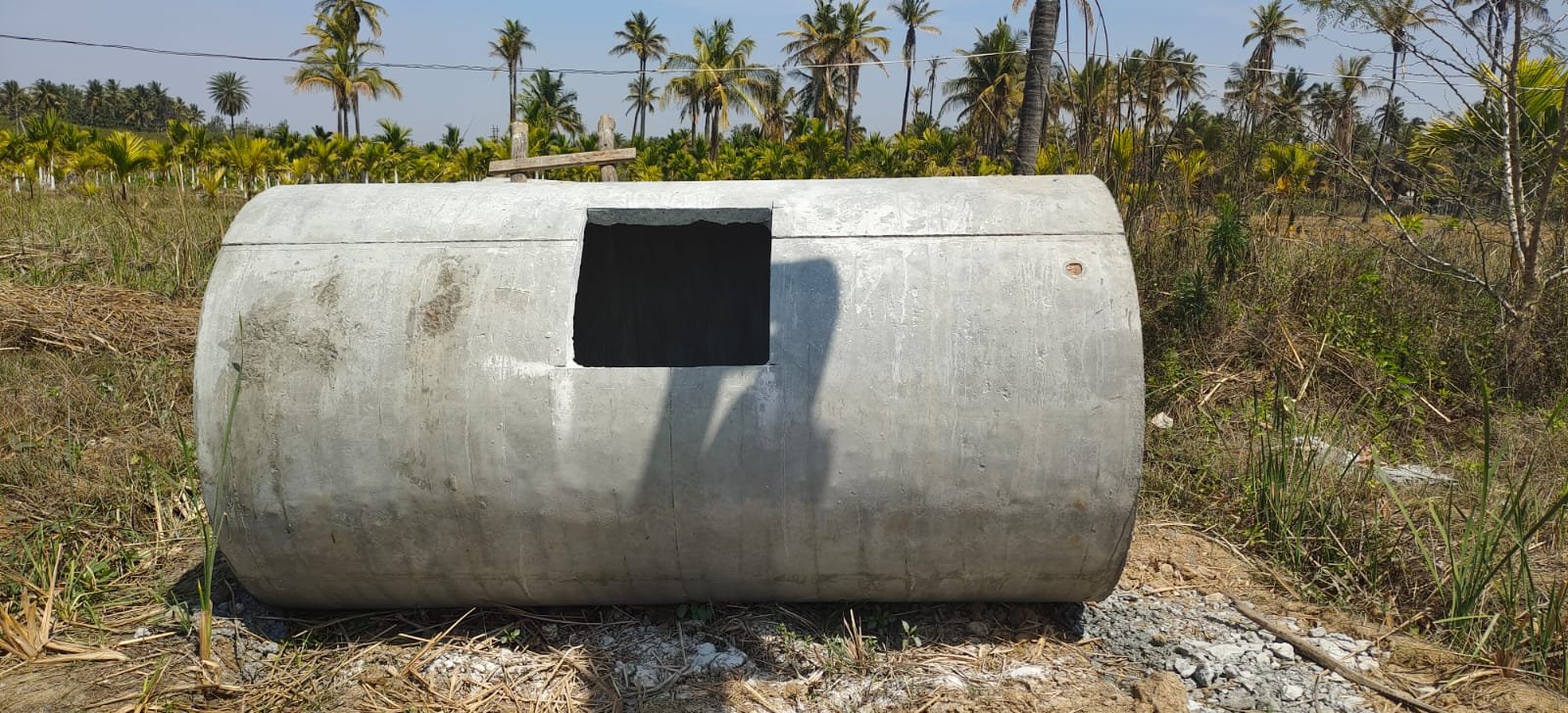
Why an Underground RCC Sump Beats a Plastic Sump
Plastic (HDPE) sumps are quick to drop into a pit, which is why builders in a hurry like them. But for a tank that must sit under your driveway for the next thirty years, a concrete water tank in Karnataka conditions wins on almost every point that matters.
| Factor | RCC underground tank | Plastic sump |
|---|---|---|
| Crush strength under driveways | Structural concrete walls and a reinforced cover slab take vehicle loads when designed for it | Walls can deform or crack under soil and wheel loads; needs a separate protective slab |
| Water temperature | Thick concrete walls and earth cover keep water noticeably cooler through Karnataka summers | Thin walls transmit ground and surface heat more readily |
| Service life | Decades — it is a permanent structure, like a foundation | Considerably shorter; brittleness and joint failures develop over time |
| Behaviour in high water table | Heavy — stays put even when empty during the monsoon | A light empty tank can float and pop out of the ground when groundwater rises |
| Custom sizes & fittings | Built to your exact capacity and inlet/outlet layout | Limited to catalogue sizes |
| Repairability | Local mason can patch, re-plaster or re-coat | Cracked plastic is rarely worth repairing |
That flotation point deserves emphasis. In parts of Tumkur and Hassan districts the water table rises sharply after a good monsoon. An empty plastic sump is essentially a sealed air bubble — buoyancy can lift it, snapping pipe connections and heaving the paving above. A concrete tank's self-weight resists uplift. The same concrete-vs-plastic logic applies to buried pipelines — see our RCC vs plastic pipes comparison.
Typical Capacities & How to Size Your Tank
The standard planning figure used in India is 135 litres per person per day (LPD) for domestic use. The sizing thumb rule is simple:
Tank capacity = number of people × 135 LPD × days of storage you want
Most households keep 2–3 days of storage as a buffer against supply gaps and pump failures. Farms add livestock and irrigation-holding needs on top.
| Household / use | Calculation | Suggested sump capacity |
|---|---|---|
| Family of 4, 2 days' storage | 4 × 135 × 2 = 1,080 L | 1,000 – 1,500 litres |
| Family of 6, 2 days' storage | 6 × 135 × 2 = 1,620 L | 1,500 – 2,000 litres |
| Joint family of 10, 3 days' storage | 10 × 135 × 3 = 4,050 L | 4,000 – 5,000 litres |
| Small apartment (4 flats) | 16 persons × 135 × 2 = 4,320 L | 5,000 litres or more |
| Farmhouse with cattle shed | Domestic demand + livestock + washing-down water | 6,000 – 10,000+ litres (site-specific) |
As a geometry check: 1,000 litres is 1 cubic metre, so a 5,000-litre tank is roughly a 1.7 m × 1.7 m × 1.7 m internal volume. Wall thickness and reinforcement depend on the tank size, depth and the load above — we detail these per order, and a spec sheet for your size is available on request.
Site Preparation Basics
A good tank on a bad base will still give trouble. Before the tank goes in:
- Location: keep the maximum practical distance from soak pits, septic tanks and drains, and keep plumbing runs to the supply inlet and pump short.
- Excavation: allow working margin around the tank for placement and backfilling.
- Bedding: a level, well-compacted base — typically compacted earth topped with a lean concrete (PCC) mat — so the floor is uniformly supported and does not settle unevenly.
- Penetrations first: finalise inlet, pump outlet, overflow and washout positions before casting. Field-chiselled openings are the most common cause of later leaks.
- Backfill in layers: compact evenly all round so no wall carries lopsided soil pressure.
- Slab and access: a reinforced cover slab with a well-seated manhole cover — designed for vehicle load if under a driveway.
Leak-Proofing, Honestly Described
Buyers deserve a straight answer here. Concrete is not magically waterproof — it is made water-retaining by doing three things well:
- Dense, compacted concrete. Water passes through voids, not through sound concrete. Machine compaction — the same principle behind spun (centrifugally cast) pipe manufacture — drives out entrapped air and packs the mix tight. Dense concrete has low permeability by nature.
- Proper curing. Concrete that dries out early stays porous and cracks. Full water curing lets the cement hydrate completely, which is what actually closes the pore structure. This is a non-negotiable step in our production process.
- Good detailing at joints and openings. Most "tank leaks" are not through the wall at all — they occur at construction joints, pipe entries and badly seated covers. Cast-in sleeves and careful mortar packing around penetrations prevent this.
On top of the structural concrete, an internal cement plaster finish with waterproofing compound, or a food-safe waterproof coating, is a worthwhile additional safeguard — especially for drinking-water tanks. We will tell you plainly which finish suits your use; we do not claim any tank is "leak-proof forever regardless of installation", because backfilling, plumbing connections and slab work done on site also decide the outcome. What we control — mix, compaction, curing, dimensions — we control strictly.
Maintenance: A Simple Cleaning Schedule
- Every 6 months: drain the tank, scrub walls and floor with a brush (no harsh acids), remove settled silt, rinse, disinfect with a mild chlorine solution, rinse again and refill. Borewell water with heavy silt may need a shorter cycle.
- Every 6 months (same visit): check the manhole cover seating, the overflow mosquito screen and the inlet strainer.
- Annually: inspect the internal plaster/coating for wear and patch if needed — a half-day mason job that keeps the tank in service indefinitely.
- Always: keep the cover closed and locked. Sunlight breeds algae; open covers invite debris and mosquitoes.
RCC Sumps for Rainwater Harvesting
Rainwater harvesting is mandatory for many urban plots in Karnataka and simply sensible everywhere else. An RCC underground sump is the natural storage element: rooftop water passes through a first-flush diverter and filter, then into the sump for direct use or gradual recharge. Because our tanks are custom-built, the extra inlet, filter connection and overflow-to-recharge-pit outlet can all be cast in from day one. For farms, a sump collecting shed-roof runoff can carry cattle through the dry months.
What Does an RCC Underground Water Tank Cost?
Because every tank is built to order — capacity, depth, cover-slab loading and finishes all vary — we do not publish a flat rate list for tanks. Pricing follows the material content: bigger capacity, thicker walls and a vehicle-rated cover slab cost more. Any figure we quote is indicative, ex-factory, and varies with cement and steel prices — call for today's rate. Share your required capacity and site conditions and we will give you a firm written quotation, usually the same day. Transport and GST are extra, as with all our precast products; our RCC pipe price guide explains how concrete product pricing works generally.
Frequently Asked Questions
How long does an RCC underground water tank last?
A well-built and well-cured RCC tank routinely serves for decades — it is a structural concrete element, similar in life to your house foundation. Plastic sumps typically need replacement much sooner, particularly under trafficked areas.
Can I park a car over an RCC underground sump tank?
Yes, if it is designed for it. The cover slab must be reinforced and detailed for vehicle load, bearing on the tank walls. Mention driveway placement at the enquiry stage so we design the roof slab accordingly.
Do RCC water tanks leak?
Sound, dense, cured concrete does not leak through its body. Leaks, when they happen, are at joints, pipe entries or poorly done site work. Dense compaction plus full curing, with an internal plaster or waterproof coating as a safeguard, is the honest and effective recipe.
How often should an underground sump tank be cleaned?
Roughly every 6 months for drinking-water sumps: drain, scrub, de-silt, disinfect and refill, checking the cover and screens at the same visit. Silty borewell supply may require more frequent cleaning.
Need an RCC underground water tank or pipes for your project?
Factory-direct prices from our Kunigal & Tiptur units. Custom tank sizes built to order. Serving all of Karnataka since 1998.
📞 7760337303💬 WhatsApp UsRelated Guides
- RCC Pipes vs Plastic Pipes — the same concrete-vs-plastic trade-offs, applied to buried pipelines.
- How RCC Spun Pipes Are Manufactured — the dense-concrete compaction and curing process behind our quality.
- RCC Pipe Price Guide — how concrete product pricing works and current indicative ranges.
- Our RCC Hume Pipes — NP2 & NP3 spun pipes, 300 mm to 1600 mm, made to IS 458 specifications.